Most homeowners ask us about washing their filter right after they find out this size doesn’t live on the shelf at their local hardware store. We get it — when you can’t just run out and grab a replacement, the idea of rinsing the old one and putting it back feels like a reasonable workaround. It isn’t. And understanding exactly why will change how you think about this filter.
The 11.25x19.25x4 air filter does more than most people realize. Every time your HVAC system runs — and in a typical home, it runs most of the day — that filter is the only thing standing between your family and the steady circulation of dust, pollen, pet dander, mold spores, and fine airborne particles your system keeps moving through your home. A compromised filter, whether overloaded or washed out, doesn’t just perform poorly. It can actively make things worse.
After manufacturing millions of filters across hundreds of sizes, we’ve learned two things about the homeowners who ask the best questions: they’re the same people who change their filters on schedule, notice when their system sounds off, and take the air their family breathes seriously. That’s exactly who this page is for. Here’s what you need to choose the right 11.25x19.25x4 filter, install it correctly, and never get stuck scrambling for a replacement at the wrong moment.
Learn more about how air filters work at the component level at Wikipedia: Air Filter.
TL;DR Quick Answers
11.25x19.25x4 Air Filters
The 11.25x19.25x4 is a 4-inch deep pleated air filter designed for residential and light-commercial HVAC systems with non-standard return air duct configurations. Because it falls outside the most common residential sizes, it is rarely stocked on shelves at Home Depot, Walmart, or similar retailers.
What it does: Traps airborne particles — dust, pollen, mold spores, pet dander, and fine particulate matter — every time your HVAC system cycles air through your home.
Available MERV ratings:
MERV 8 — everyday protection for standard households
MERV 11 — added capture for mild allergy sensitivity or light pet dander
MERV 13 — recommended by the EPA for households with pets, allergy sufferers, young children, or elderly residents
Replacement schedule: Every 60 to 90 days for standard use. Every 30 to 45 days in homes with pets or allergy-sensitive occupants.
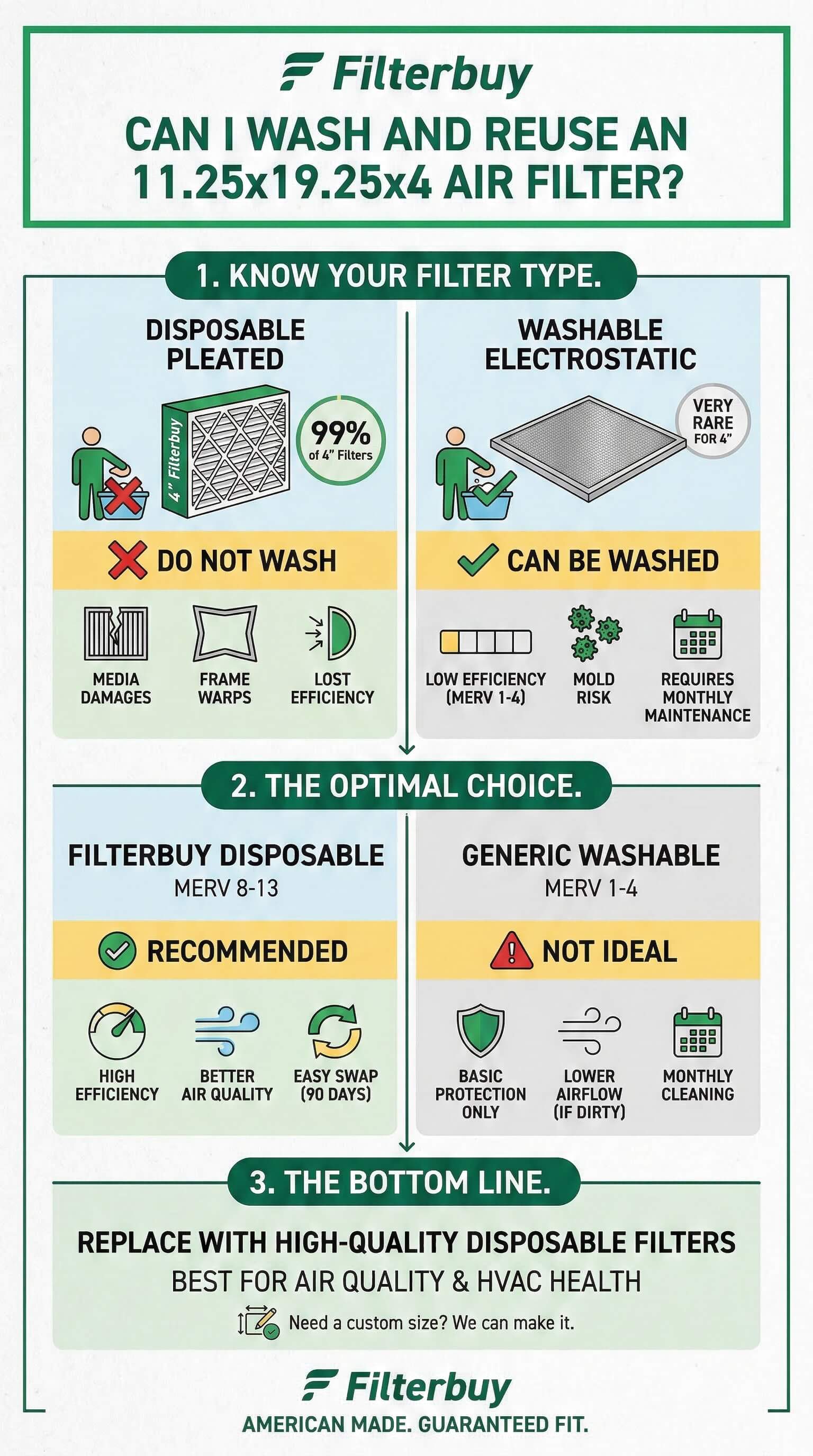
Can you wash it? No. Standard pleated 11.25x19.25x4 air filters are single-use. Washing collapses the fiber media and eliminates filtration capability.
Where to buy: Order directly from a manufacturer that precision-cuts to exact nominal tolerances. This size is a non-standard dimension — an imprecise fit creates an air bypass gap that lets unfiltered air circulate freely through your system, defeating the filter entirely.
Pro tip from our manufacturing team: After producing filters across millions of units, the most common air quality failure we see has nothing to do with MERV rating. It's a filter running two to three months past its replacement date. Keep a multi-pack on hand so you're never in that position.
Top Takeaways
• Standard 11.25x19.25x4 pleated air filters are single-use only. Washing them collapses the fiber media and destroys filtration performance.
• This is a non-standard size. Big-box retailers rarely stock it consistently — ordering directly from a manufacturer ensures correct dimensions and reliable availability.
• MERV 8 covers most standard households. MERV 13 is the EPA- and Lung Association-recommended standard for households with pets, allergy sufferers, or young children.
• Filter fit matters as much as MERV rating. An undersized filter creates an air bypass gap that allows unfiltered air to move freely through your system.
• Replace every 60 to 90 days for standard households. Replace every 30 to 45 days for pet homes or allergy-sensitive environments.
• Buying in bulk multi-packs is the practical solution for a hard-to-find size — lower cost per filter and a replacement always on hand before you need one.
• Set a reminder at installation. The most common air quality failure we see isn’t a wrong MERV rating. It’s a filter running months past its replacement date.
What Is an 11.25x19.25x4 Air Filter and What Systems Use It?
The 11.25x19.25x4 is a nominal filter size — meaning the actual frame dimensions run slightly smaller than the number suggests. This size fits a specific group of residential and light-commercial HVAC systems, particularly those with non-standard return air duct configurations.
Because it’s not one of the most common residential sizes, this filter rarely shows up on shelves at big-box retailers. That gap matters more than most homeowners expect. When you can’t find your size locally, the temptation is to grab something close enough and force it to fit. We’ve seen what that produces across thousands of service calls: undersized filters that create air bypass gaps, dirty coils, strained blowers, and rising energy bills that feel like a mystery until a technician opens the cabinet.
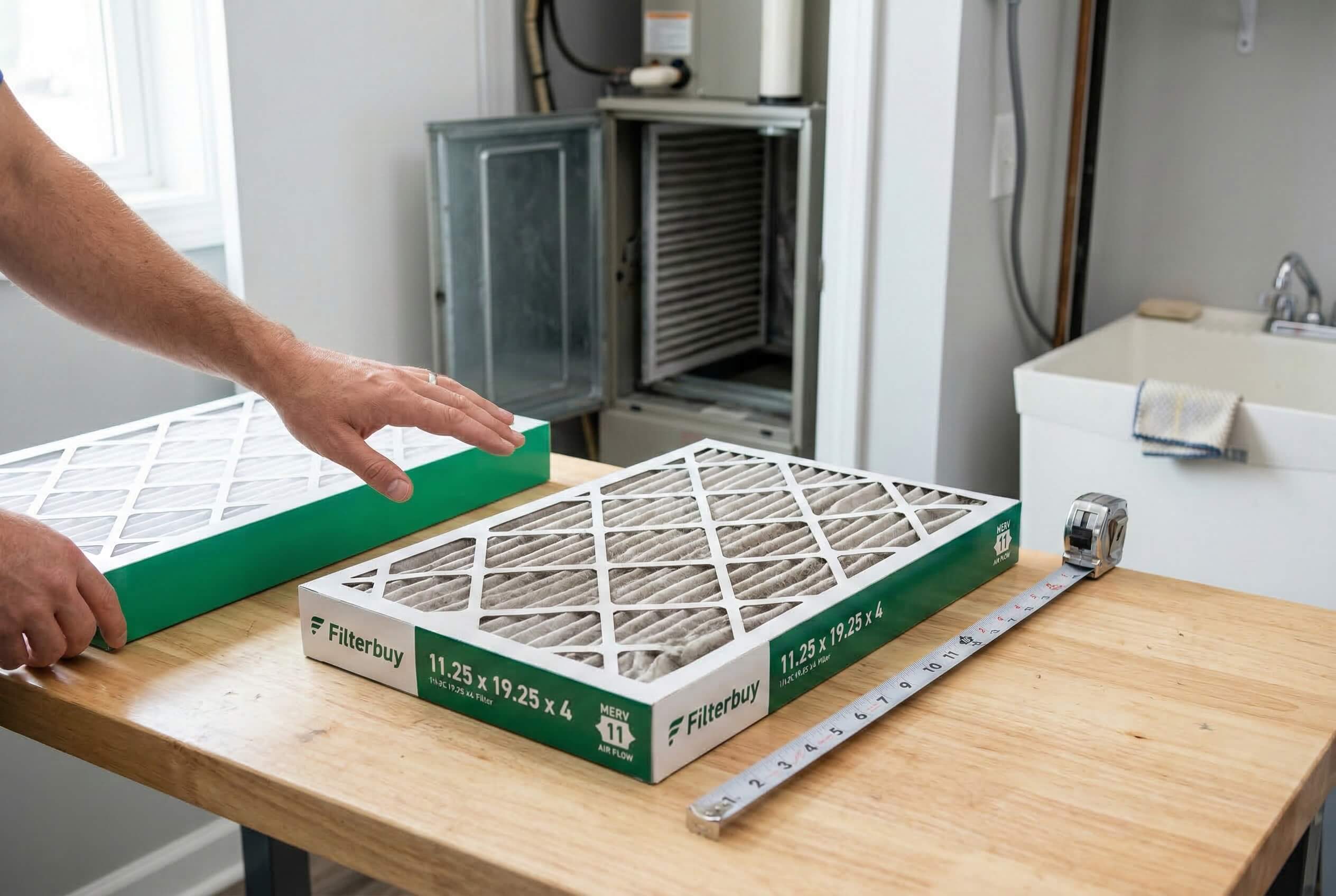
If your unit requires an 11.25x19.25x4, the fit precision matters. A filter that’s even a quarter-inch too small lets unfiltered air route around the media entirely. Our manufacturing process machines every filter to exact nominal tolerances so the fit is consistent every time — not approximate.
Can You Wash and Reuse an 11.25x19.25x4 Air Filter?
The Direct Answer
No. Standard pleated 11.25x19.25x4 air filters are single-use only. They’re not designed to be washed, rinsed, vacuumed, or cleaned for reuse.
Pleated filter media works by trapping particles within a tightly layered matrix of polypropylene or polyester fibers. Introduce water to that fiber matrix — even carefully — and several things happen at once: the fibers collapse inward, the precise spacing between them that determines filtration efficiency disappears, and the structural integrity of the pleat formation breaks down. What you get back is a wet, misshapen filter that has lost nearly all ability to capture airborne particles.
What About Washable Filters?
There is a category of washable HVAC filters — typically made from electrostatic polypropylene or woven metal mesh — that manufacturers design specifically for cleaning and reinstallation. These are fundamentally different products from pleated media filters. They carry lower MERV ratings, usually in the MERV 4 to 8 range, and need very specific cleaning procedures plus full dry time before going back in.
If washability matters for your household, choose a purpose-built washable filter rather than trying to clean a pleated product. The performance tradeoff is real. In our experience, washable filters consistently capture fewer fine particles than a fresh pleated filter of equivalent thickness. For some households, the convenience matters more than the filtration gap — but know what you’re trading before you decide.
Choosing the Right MERV Rating for Your 11.25x19.25x4 Filter
MERV — Minimum Efficiency Reporting Value — is the standardized scale ASHRAE developed to measure how effectively a filter captures airborne particles. It runs from 1 (nearly no filtration) to 20 (hospital-grade). For residential HVAC, the meaningful range is MERV 8 through MERV 13.
MERV 8 — Reliable Everyday Protection
A MERV 8 filter captures dust, pollen, mold spores, dust mite debris, and pet dander in the 3 to 10 micron range. It’s the right call for most standard households with no significant allergy concerns and a reasonably modern HVAC system.
Best for: Average households, standard maintenance schedules, older HVAC systems with limited static pressure tolerance.
MERV 11 — A Practical Middle Ground
MERV 11 adds capture capability in the 1 to 3 micron range — picking up finer dust, auto-emissions particles, and Legionella bacteria. It’s a meaningful step up from MERV 8 without the airflow restriction of MERV 13.
Best for: Households with mild allergies, mixed-use spaces, or aging residents who want added protection without straining the system.
MERV 13 — Serious Protection for Sensitive Households
MERV 13 is where filtration becomes genuinely meaningful for respiratory health. Filters at this rating must demonstrate at least 50% removal efficiency for particles in the 0.3 to 1 micron range — capturing fine dust, smoke, bacteria, and a portion of virus-carrying particles. The EPA specifically recommends MERV 13 for households prioritizing indoor air quality.
Best for: Pets in the home, allergy or asthma sufferers, young children, elderly residents, or anyone in a high-dust environment.
A Note on System Compatibility
Higher-MERV filters create more resistance than thinner or lower-rated ones. Most modern systems handle MERV 13 without issue. Older systems — particularly those with undersized ductwork or weaker blower motors — may do better with MERV 8 or 11 to maintain adequate airflow. When in doubt, check your HVAC manual or ask a certified technician before upgrading.
How to Install an 11.25x19.25x4 Air Filter
Installation takes about five minutes. Here’s the exact process:
1. Power down your HVAC system at the thermostat before opening the filter housing. This prevents unfiltered air from pulling into the system during the swap.
2. Locate your filter slot — typically at the return air grille, air handler cabinet, or furnace housing.
3. Slide out the old filter and dispose of it without shaking or tapping it. A loaded filter carries everything you’ve kept out of your air, and disturbing it releases those particles back into the room.
4. Check the airflow direction arrow on the new filter frame. It must point toward the blower motor — toward the system, away from the return air side.
5. Slide the new 11.25x19.25x4 filter into the slot with the arrow pointing correctly. The filter should seat flush with no gaps at the edges.
6. Close and secure the filter housing. Restore power to the thermostat.
Set a replacement reminder the moment the new filter goes in. The single most effective filter maintenance habit isn’t choosing the perfect MERV rating — it’s replacing the filter before it loads up enough to restrict airflow and strain your system. Every 60 to 90 days for standard use. Every 30 to 45 days for homes with pets or allergy sufferers.
Why Order Your 11.25x19.25x4 Filter Online Rather Than Locally?
The short answer: most retailers don’t stock this size. The 11.25x19.25x4 falls outside the high-volume standard sizes that Home Depot, Walmart, and Amazon warehouse in quantity. You may find it listed online through those retailers, but availability is inconsistent and delivery timelines vary.
Sizing precision matters more than most people think, too. A filter cut even slightly undersized creates a bypass gap at the edges of your housing — and a bypass gap means unfiltered air circulates freely through your system. Over time, that shows up as a dirty coil, a strained blower, reduced airflow, and an energy bill that keeps climbing without an obvious explanation.
When you order directly from a manufacturer who precision-machines every filter to exact nominal tolerances, you get a fit you can count on every time. We also offer multi-pack bulk pricing on the 11.25x19.25x4 in MERV 8, MERV 11, and MERV 13 — so you always have a replacement ready before the current one hits its limit.
“We hear the washable filter question constantly, and the instinct behind it is a good one — homeowners want to spend less and waste less. But after manufacturing filters across millions of units and reviewing performance data from thousands of HVAC systems, the evidence is consistent: pleated media simply isn’t built for rewashing. The fiber structure that makes a pleated filter work is exactly what water destroys. What concerns us beyond the filtration loss is the secondary effect — a damaged filter loads unevenly, creates pressure differentials across the media face, increases bypass airflow, and makes the blower work harder against the restriction. For a less-common size like the 11.25x19.25x4, the smarter move is keeping a few replacements on hand so you’re never tempted to push a dirty filter past its limit. A fresh filter changed on schedule protects more than your air. It protects your entire system.”
— Filterbuy Air Filtration Manufacturing Team
Essential Resources
Seven authoritative sources from government and health organizations to support your research on air filtration, MERV ratings, and indoor air quality. Every resource below comes from a verified .gov or .org domain.
1. U.S. EPA — Guide to Air Cleaners in the Home
The EPA’s consumer guide to selecting HVAC and furnace filters, including MERV rating explanations and indoor air quality guidance for residential systems.
https://www.epa.gov/indoor-air-quality-iaq/guide-air-cleaners-home
2. U.S. EPA — Indoor Air Quality
The EPA’s overview of indoor air quality, including pollutant concentration data and foundational research showing indoor air is often 2 to 5 times more polluted than outdoor air.
https://www.epa.gov/report-environment/indoor-air-quality
3. U.S. EPA — What Is a MERV Rating?
Plain-language explanation of the MERV scale, including guidance on selecting the right MERV rating for residential furnace and HVAC filters.
https://www.epa.gov/indoor-air-quality-iaq/what-merv-rating
4. U.S. Department of Energy — Operating and Maintaining Your Heat Pump
DOE guidance on proper HVAC filter maintenance, including recommended replacement intervals and the connection between filter care and system efficiency.
https://www.energy.gov/energysaver/operating-and-maintaining-your-heat-pump
5. U.S. EPA — The Inside Story: A Guide to Indoor Air Quality
The EPA’s foundational resource on indoor air pollutants, covering sources, health effects, and the role of HVAC filtration in reducing indoor pollutant concentrations.
https://www.epa.gov/indoor-air-quality-iaq/inside-story-guide-indoor-air-quality
6. American Lung Association — Air Cleaning
The Lung Association’s guide to HVAC filter selection, MERV rating recommendations, and the health benefits of upgrading residential air filtration.
https://www.lung.org/clean-air/indoor-air/protecting-from-air-pollution/air-cleaning
7. Wikipedia — Air Filter
A broad educational overview of air filter types, construction, and function — useful background for understanding the differences between filter media categories.
https://en.wikipedia.org/wiki/Air_filter
Supporting Statistics
Stat 1 — Your home’s air is likely more polluted than the air outside
According to the U.S. Environmental Protection Agency, concentrations of some pollutants run 2 to 5 times higher indoors than in typical outdoor air — and Americans spend roughly 90% of their time indoors.
Source: U.S. EPA — Indoor Air Quality — https://www.epa.gov/report-environment/indoor-air-quality
Our take: That gap isn’t a fixed condition. It’s directly shaped by how well your HVAC filtration is performing. A properly rated, properly sized filter changed on schedule is the most direct action a homeowner can take against indoor air pollution. The 2 to 5x figure isn’t there to alarm you — it’s there to make the case that this filter matters more than most people give it credit for.
Stat 2 — MERV 13 is the EPA’s benchmark for meaningful filtration
The EPA’s Guide to Air Cleaners in the Home states that filters rated MERV 13 and above must demonstrate at least 50% removal efficiency for the smallest particles tested — the fine particulate matter (PM2.5) of greatest concern for respiratory health.
Source: U.S. EPA — Guide to Air Cleaners in the Home — https://www.epa.gov/indoor-air-quality-iaq/guide-air-cleaners-home
Our take: That 50% threshold is exactly why we consistently point households with pets, allergy sufferers, or young children toward MERV 13. MERV 8 does real work on larger particles — dust, pollen, dander. But if fine particles are your concern, MERV 13 is the standard that actually moves the needle. We offer both on the 11.25x19.25x4 because different homes have different needs. We’d rather help you choose the right filter than default you to any particular option.
Stat 3 — The American Lung Association recommends MERV 13 or higher
The American Lung Association recommends upgrading residential furnace filters to a MERV rating of 13 or higher to capture more and smaller particles, and advises changing filters approximately every two months or when visibly dirty.
Source: American Lung Association — Air Cleaning — https://www.lung.org/clean-air/indoor-air/protecting-from-air-pollution/air-cleaning
Our take: Two months is a useful upper bound, but it’s a generalization. Homes with pets or heavy dust loads should target 30 to 45 days. For a harder-to-find size like the 11.25x19.25x4, where running to the hardware store isn’t a quick option, keeping a multi-pack on hand is what makes that two-month guideline actually achievable in practice.
Final Thoughts & Opinion
Here’s our honest read on the washable filter question, after a decade of making them: the instinct is right, even when the answer is no.
Homeowners who ask about cleaning their filter are the same people who replace it on schedule, catch problems early, and think seriously about the air their family breathes. That’s the Prudent Protector mindset — and it’s exactly the kind of attention that keeps an HVAC system running well for 15 years instead of 10. We’re not here to talk you out of wanting to do more with less. We’re here to redirect that energy toward what actually works.
For the 11.25x19.25x4 specifically: confirm your sizing is correct, choose the highest MERV rating your system can handle, buy a few extras so you’re never running a filter past its useful life, and set a calendar reminder so replacement becomes a habit rather than a reaction. That’s the whole picture.
Air quality in your home is mostly invisible. You can’t see a loaded filter failing. You can’t see particles moving through a collapsed media structure. What you can see is a clean filter going in on schedule — and know, with confidence, that the protection is there.
Frequently Asked Questions
Q: Can I wash and reuse my 11.25x19.25x4 air filter?
No. Standard pleated 11.25x19.25x4 filters are built for single use. Water collapses the polypropylene or polyester fiber matrix that gives the filter its capture ability. Once washed, the filter can’t effectively trap airborne particles — and may push previously captured contaminants back into your airstream. Replace on schedule rather than trying to clean.
Q: What MERV rating should I choose for my 11.25x19.25x4 filter?
Choose MERV 8 for standard households with no specific air quality concerns. Choose MERV 11 for mild allergy sensitivity or a household with one or two pets. Choose MERV 13 if your home has multiple pets, allergy or asthma sufferers, young children, or elderly residents. The EPA recommends MERV 13 as the residential standard for capturing fine particles of greatest health concern.
Q: Where can I find an 11.25x19.25x4 air filter near me?
This size is rarely stocked on shelves at Home Depot, Walmart, or similar retailers — it falls outside the standard residential dimensions most stores warehouse in volume. Ordering directly from an online filter manufacturer that precision-cuts to exact nominal dimensions is the most reliable option. You’ll get the correct fit, your choice of MERV rating, and the option to buy multi-packs so you always have a replacement ready.
Q: How often should I replace my 11.25x19.25x4 air filter?
Every 60 to 90 days for a standard household. Every 30 to 45 days if you have pets, allergy or asthma sufferers, or high dust levels. The 4-inch deep filter holds more media than a 1-inch filter and can handle longer intervals under moderate conditions — but don’t stretch it past 90 days. A loaded filter restricts airflow, makes your system work harder, and pushes your energy bill up.
Q: Is buying an 11.25x19.25x4 air filter in bulk worth it?
For this size, yes. Because the 11.25x19.25x4 isn’t a standard shelf item at local retailers, running out means either waiting on shipping or running your system with an overloaded filter. A multi-pack delivers a lower cost per filter and removes the most common filter maintenance failure we see: delaying a replacement because you didn’t have one on hand. If your replacement interval is 60 days, a 4-pack covers most of a year in a single order.
Get Your 11.25x19.25x4 Filter — Exact Fit, Every Time
Stop searching store shelves for a size most retailers don’t carry. Order your 11.25x19.25x4 directly from the manufacturer — exact fit, your choice of MERV 8, MERV 11, or MERV 13, with bulk multi-pack pricing delivered to your door. Shop now and take the guesswork out of protecting your HVAC system and your family’s air.
Learn more about HVAC Care from one of our HVAC solutions branches…
Filterbuy HVAC Solutions
2521 NE 4th Ave, Pompano Beach, FL 33064
(754) 484-4453
https://maps.app.goo.gl/JmWkEXya7uzuLzBh8